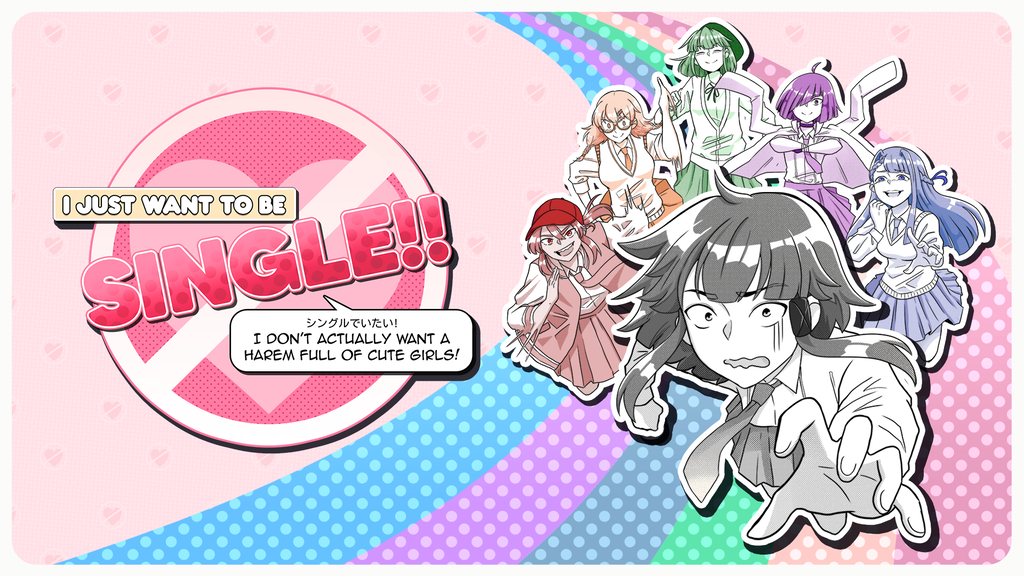
I Just Want to be Single!! - Anti-Dating Sim Visual Novel
Created by Tsundere Studio
The anti-dating sim where you make friends instead of girlfriends!
Latest Updates from Our Project:
Dealing with Feedback and Criticism
over 3 years ago
– Sun, Jan 15, 2023 at 10:13:24 AM
hey, it's m.
the tl;dr of this update - honestly not much this month, feel free to skip reading this one.
Eyedress - Jealous
There honestly isn't much to talk about this month in terms of concrete updates. November and December have been both very slow in terms of production on the game, although you can expect to see more next month.
That being said, I do have something I can talk about in terms of what I do most of the time as the Creative Director for IJWTBS.
It's no secret that there's quite a few people working on the game, although it is hard to say we operate as a real 'studio' in any sense of the word. Mostly it's just hiring a lot of freelancers that we hire since I'm not Toby Fox and I can't do everything myself.
I'm very hands-on with all sections of the process, and each individual person (like the artists and writer and composer etc.) I speak with personally every day with.
Over the course of development of the game and also while working as a freelancer before IJWTBS, I've come to experience dealing with criticism and feedback all these years, and I think it is an incredibly important skill whether you're hiring someone, being hired by someone, operating in a workplace environment, you'll need to efficiently communicate with other people if you want to be successful.
Feedback is crucial for development because no single person has all the answers, and having a second opinion can vastly improve on something you're working on compared to if you were working on it without it.
It's incredibly important to gain perspective and improve on our work, good feedback/criticism is hard to find. And that's why we tend to have a lot of negative perceptions associated with it most of the time. So let's talk about it.
Here's 5 steps that will help you give and take good feedback and criticism.
1. Context
The first thing to do is to recognize the context of the situation.
Is it a friend asking for feedback? Maybe you're asking advice from a teacher or your boss? How about feedback when it comes to commissioning artwork? All of these different situations can change the context of what should and shouldn't be said.
Now this is important, because if you don't properly identify the context and the proper source of the feedback you're getting, or what position you're giving it from, you won't be able to know if the feedback is relevant, important or even necessary.
If you treat every piece of feedback as the same, you won't be able to properly gain a good amount of information out of it. For example, if someone randomly on the internet said "This sucks!" about your project, is that really the same as if someone you trust, or someone you believe to have a knowledgeable opinion said something critical about your project?
A hard pill to swallow for a lot of creatives and indies just starting out their careers is that they shouldn't listen to each piece of feedback like they are all equally important or relevant (even in cases where people praise your work.) Not all feedback is constructive, or even necessarily useful feedback at all even if it is 'positive' feedback. Everyone has an opinion, but not every opinion is relevant to your situation and needs.
It's also important to know when feedback should be given. Someone might not be ready to hear feedback at the moment, so you should be aware of if they are clearly asking for feedback, and you should also ask for what type of feedback they're looking for.
If someone comes to you and asks 'what is your opinion on this' are they asking for feedback? Or are they asking what you think on an emotional level? What is the goal that we're trying to reach through this feedback? Those are the kinds of questions you need to be asking yourself, which leads to the second point-
2. Objectives and Goals
Feedback is something that you use in order to keep check of whether or not what you're doing is aligned with your goals. In other words, we want to know if something is 'good' or not.
But often times, we fail to properly have established goals and objectives when we are asking for feedback and that makes it so much harder to both give and take feedback. That's why whether you're asking or giving feedback, you always need to establish the objective behind the question.
We can't ask people if something is 'good' or not because different people have different ideas of what 'good' is. So you want to frame your feedback in neutral, goal oriented terms.
"Do you think this is realistic?" "Do you think I've improved?" "Do you think that this feels [x]?"
Specifying the question while also separating what is objective and subjective helps a lot more when it comes giving and taking really good feedback. This is also heavily related to-
3. Emotional Neutrality
Good feedback often comes from an objective perspective and isn't emotionally judgmental. And I have to emphasize again, that even when feedback is positive, it doesn't necessarily mean it is critical.
You have to first observe things for the way they are, and refrain from making emotional judgments. This will allow you to be able to criticize something, while not hurting someone's feelings. And remember, not everyone has the proper knowledge or expertise to give useful feedback, but everyone does have emotions and opinions.
Really take in the time to actually observe what is in front of you and take the time to process it. Think about how you can articulate your feelings in a way that is neutral and objective.
Instead of saying "This is ugly", you can try to identify why it is making you feel that way. And instead you can say "This red is really harsh on my eyes". You're going to the root of the problem so that way the person you're giving feedback to can actually have something actionable.
Maybe you think something is extremely bad, and you want them to fix it. But telling them that it is bad isn't very helpful if you can't explain why it is bad. This obviously requires a bit of skill in terms of recognizing problems, being able to articulate them, and not having a bias, but this is how you can improve on how to give proper feedback, and the same goes for taking feedback as well.
You must also be able to interpret what someone is saying past the emotional value they put in the words. If someone says "Why is this Kickstarter Update so long?! I fell asleep halfway through reading it, damn it!" you shouldn't get caught up in how you perceive that feedback emotionally. Strip away the unnecessary words, get rid of the emotional language, and look at what the person is reallysaying.
And when you come down to the core of what that person is saying it becomes "This update should be shorter."
protip: frame things with "I" instead of "you"
"You did this wrong" vs "I feel like this could be better"
It sounds way more neutral and less violent
4. Being clear and concise
Even if you're coming from a place of good intentions and/or expertise, it's not gonna be very useful if you're not able to articulate something in a reasonable way.
It's really important to have a point to what you're saying, and having a clear path to the point. Using a lot of arbitrary analogies or weird metaphors isn't very helpful, and can often just lead to confusion. Actually take your time to think about what you're going to say, take a moment, clarify, and then speak your mind. It's no use in having a conversation if it just becomes a mess of non sequiturs and hyperbole.
5. Being thorough and Honest
People often call this the 'sandwitch method', which is pretty apt. When you're giving feedback and criticism to someone, what you do is start with what works for you, continue with what isn't working, and end on something else that works for you. So you're essentially start and ending things on a positive note.
This does work really well, but I just want to add to that with how I really feel about criticism. People often think that being honest and being polite are incompatible. But the truth is they are not mutually exclusive. You can be honest and polite, as long as you're thorough AND honest with your criticism.
You may feel that something is bad (or good for that matter), and that may be your honest feelings about it. There's nothing that can change that and nobody can tell you otherwise. But you also need to be thorough and unbiased and really think about every part of what you're judging equally.
I often see these multi-hour analysis videos on games or movies with titles like "[title] is good/bad and here's why", and often when I get to the end of the video I feel like the person explaining things to me has spent the whole runtime about why they personally liked or disliked the thing in question, rather than what was actually good or bad about it.
I feel this way because they overlook the other side of feedback. Saying what's actually bad if you're praising it, and saying what's actually good if you're criticizing it. That's what I mean by being thorough. When you're asking for feedback you also need to also be honest when it comes to what you really want to hear.
And if you feel like something is bothering you, don't wait until the whole thing is done and over before you say it! Bring up your honest feelings and give input even if you don't think it will result in a different outcome, it's better to at least have brought it up. Who knows, maybe it might turn into something really great that the other person hasn't through of! And similarly, if you see something done well, don't forget to point it out to them!
And, that's it!
Those are all the things you need to keep in mind, when it comes to giving and taking good feedback, and they're all things I'm going to need to go back to and think about when this game finally releases this year.
Thanks for reading this month's update, apologies if it was a little too removed from IJWTBS, but hopefully it shows you some insight into what I do every day as a creative director on the project.
Let me know if YOU have feedback for these updates ;)
(and lmk what else you want to read me ramble about)
The most important part of games are invisible
over 3 years ago
– Fri, Dec 16, 2022 at 12:43:58 AM
hi I'm m. (and I'm saying that as if you didn't know that already)
The tl;dr - UI is important. That's it.
MGS3 - Snake Eater
Wow. It's already almost 2023. Can you believe it?
But I'll save the end-of-year-reminiscing for later. Today, let's talk about arguably the most boring part of games. The user interface.
UI or user interface have an extremely important yet difficult job, not just in video games but across all of design. UI needs to be accessible, functional, good looking yet not too noticeable all at the same time. What a monumental task.
When you look at a game you've never seen before, more often than not, the UI is going to be the first thing your eyes flit towards for you to understand the game. Are there two big health bars at the top? It's a fighting game. Is there a aim reticle in the middle with some ammo counters in the corner? It's an FPS.
UI arguably shape what games are from the initial point of design, and that is definitely true for IJWTBS.
There was a lot of struggle I went through when shaping the UI of IJWTBS. Sure, it doesn't look like much but every micro decision actually impacts the player's experience in a very big way.
In very early stages of the game, it started out not much different from any other visual novel. There's a textbox. That's it.
But the very first thing I added became the most important part of the game from that point on.
The heart meter.
It was something that I always imagined in my head and it was something that spoke to the idea of the premise and the game as a whole. It represented Aya's conflict of desiring to be likable, but not too likable.
Fill the meter, and you might find yourself in an unwilling relationship. Empty the meter, and the girl in question dislikes you too much to be your friend. This was the core fundamental idea of the game.
Not only that, it also fixed one nagging issue I've always had with dating sims. If you pick the "bad" option, it was game over. You were locked into a bad ending. You couldn't just have fun and say the funny option because the game didn't want you to. And I always thought "well, if that's the case why even give me a choice at all?"
With the meter, it allows players to pick the dumb stupid option and have a laugh and not immediately lose. Because sometimes you have to pick the dumb stupid option! That's the objective of the game!
Next, I really liked the idea of the game themed around a Manga aesthetic. After all, a lot of the inspiration for IJWTBS comes from manga and anime. I had the idea of making the textbox looking like speech bubbles you see in comics and manga, and each time a different character speaks, the speech bubble would move.
Now, I couldn't exactly make the speech bubble itself move, but I COULD move the bubble "tail". This was good enough for my purposes, which was to indicate who is speaking visually.
I did change the aesthetic to a more manga looking theme later on. As well as moving the name plate for the speaking character. It was getting in the way of the speech bubble "tails."
From that point on, I had to figure out how to design around this "heart meter" mechanic and how the player would influence the meter through playing the game.
Initially, as does every other visual novel has, IJWTBS had dialogue options that you can click.
Now, there's nothing wrong with the traditional style of choice buttons. But to me, it didn't quite feel right. I wanted something that felt really impactful, something that make the act of choosing what to say feel divisive.
Here I was being reaaallly experimental with the mechanics, just going wild with it. Most of the time it didn't even make sense but I just wanted to try things.
I thought of adding an indicator on the choice itself to signal that that choice would affect the heart meter positively and negatively. Since you could already see your relationship status with the character, making choices and knowing exactly what options did what to the meter (in theory) felt more impactful. I wanted the player to make more careful decisions.
There was also a whole points based system that would let the player know how much exactly it would affect the meter. So the idea was, let's say you have two choices. A and B.
A has a positive red heard with the number 3 signaling that it would give you 3 points to your meter positively. B has a negative dull heart with the number 8 on it which would take away 8 points from your meter heavily skewing it to the left side.
You knew exactly how much impact each choice would make, so you had to be careful. Maybe you didn't want to have positive points, but the negative choice would take away too many points from your meter, effectively causing you to lose. So you had to make compromises sometimes and pick some options you didn't necessarily want. (This evolved into the 'loudness intensity' mechanic way way later in the life of the game)
Now, that was all good on paper, but after some play testing with friends I quickly realized all it did was cause choices to not be impactful, in fact the opposite happened. People were funneled into a flowchart of choices because they were too busy trying to optimize their points, and as a result, they didn't pay attention the what the actual dialogue choices were, only what points they would give! That was no good.
At some point, I even added additional meters that you had to balance along with your heart meter. The green one represented Energy, and the yellow one represented Anxiety. You would have to balance all of these things at the same time to get a good result. I did all this in order to make choices impactful but, all it was doing was making the game needlessly complicated and obtuse. I scrapped all of these ideas.
Then suddenly, I had an idea. A really weird idea.
What if you could type in your choices instead of picking them? In a vacuum, it was really the exact same as just clicking a button to choose dialogue functionally, except it was more tedious. So why bother?
You see, there's something about talking to a person that is lost in visual novels. In real life, when talking to a person on the spot, you have to manually really think hard on what to say, and then actually say it. Just those actions alone are seem simple on paper, but in your brain, there's thousands of calculations going on in a second. "What do they mean? What should I say? What if I say something stupid? Oh no, they're looking right at me. I should really say something. Umm, uhh - Mozzarella Cheese."
That sort of feeling doesn't happen when all you have to do just click a button. And sure, it's not the exact same, obviously it doesn't translate 1:1 but, I HAVE witnessed live on livestreams people actually reconsidering what they're going to say within the time they are spending typing the words. So I'll consider that a success.
Now, what I didn't realize until AFTER I finished implementing the input system mechanic, that there was a problem with the input system. More often than not players tried to putting in things outside of the given prompts from Aya's thoughts. They got frustrated they couldn't say whatever they wanted whenever they wanted.
This is why I added "free input" sections in the game. These sections were solely dedicated for players to type in anything they wanted and the game wouldn't just go "BRR! WRONG!", the game would accept these inputs and that became a gag in itself. It became a part of the game.
During playtesting and the beta people told me that these sections were the most fun and memorable parts of the game along with the sections where you had to remember a certain detail, or just come up with anything. I don't doubt that, they are fun!
This then gave me the idea of Hidden Prompts. Secret options you could put into the input system that were accepted but not shown to you. A lot of people really enjoyed this idea and I think it adds a whole new layer to the game.
All that is work from before the Kickstarter though, and since then I've been able to revamp some of the UI to make it look even better with the help of graphic artist Sitraxis.
Yes, this all looks great and there's plenty of more cool and new stuff we have in store for you.
But hey, this update has been running pretty long, so I'm going to save the rest for another update.
Thanks for reading and sticking with us so far, Happy Holidays and much love
-m
The backstory of the Manga cutscenes and how we make them
over 3 years ago
– Sat, Nov 12, 2022 at 01:26:32 AM
Hi. It's me. m.
As always, we start with the tl;dr - DON'T LOSE YOUR WAYYYYY-
-in your mind We have to be as one Don't be afraid my sweet heart This is the way to be more strong
KillLaKill - Before my body is dry
I'm very much a filthy, disgusting otaku weeb and I think it certainly shows a lot in IJWTBS.
There's tons of pop culture references in the game, but the majority of them are from anime and manga based material (with the occasional nod to other games.)
A visual novel is a really cool hybrid mix of being a game, an anime and a book. It's got a good and deep story. It's got characters you want to invest in. It's got visuals and audio, and it's got gameplay. You've got everything in one big bag. Does it do everything perfectly? Depends on the VN.
graphic design is my passion
(this isn't a perfect model tho and each vn/game is different so your mileage may vary)
There is a LOT of writing in IJWTBS. A lot. And while there isn't anything wrong with reading (hey you chose to play a VN after all) I do think a nice balance of stimuli and change of pace every now and then is great for keeping the player engaged. That doesn't have to apply to just VNs.
Having a variety of things to do keeps things interesting and you'll have something to look forward to. Remember what I said in the last update? Too much salt ruins the broth. You need heterogeneity!
For this reason there's two things that serve that purpose. Cutscenes and gameplay. We'll talk about gameplay in a future update (mostly because I haven't gotten to that part in development yet.) For now, let's focus on the cutscenes, more accurately - the Manga.
Let me tell you about how I first came up with the manga styled cutscenes.
Now, when I was first thinking of the cutscenes, I was thinking- well, most VNs have CGs and illustrations as cutscenes. These do a perfectly fine job in most cases. It's a little stiff but hey, it gets the job done. Although... not quite satisfying. A comic/manga panel really conveys a lot in a very short amount of time and can fully give you a sense of space and environment at it too, while keeping things economical on the artists side. It's pretty efficient for something so stylistic.
But... that's still a little bit stiff. I want something cool, something that has movement. I wanted nothing short of actual cutscenes with fully hand drawn and animated Anime Sakuga.
My skillset and wallet disagreed.
I've never made a comic before, I don't even know how to draw! I kinda know some basic graphic design and motion design... but that's about it. Hey, wait a minute. Motion Design? That's basically like animating without the drawing part.
Hmm... I have an idea. I could animate the panels! But I still need to find someone to draw the comics and (at the time) Tsun didn't have the confidence to try manga pages. I also didn't feel confident in just hiring someone to do it because it really helps when you have at least some sort of bare minimum experience when it comes to commissioning and directing someone to do something for you.
And after all that- it's still not quite anime.
But... it's the next best thing and it was surprisingly reachable. I knew I could do it if I was resourceful enough.
So that meant I had 3 goals:
Find a manga artist
Learn the basics of manga
Animate the pages in-engine
Some weeks after my initial idea, I found someone on Fiverr to do a comic for me, or at least a single page. Great! That's step one.
But I still hadn't learned anything about manga! Shit. Oh well, I'll just quickly draw something as a reference and give it to the artist.
bruh...
Oh no. That doesn't look good. But hey, maybe I don't need to learn about manga, I mean... I'm hiring someone to do it for me anyway, right? Maybe I'm worrying too much. They'll figure it out. Probably.
Fiverr artists rendition
I mean, it looks pretty good right? I didn't really have anything to complain about... They followed my reference pretty closely. Maybe... a little too closely. (That's exactly why I can't really complain, they completely followed my instructions, so it's not their fault at all.)
The flow is a little jarring (no thanks to me) and the style is a little too western from what I would like it to be, not anime enough. I mean... there wasn't anything really that wrong with it. It was good. But was it good enough?
I wasn't 100% satisfied with it, but regardless I paid the artist and went back to the blackboard. I needed to try something else. I needed to be sure of something.
Fast forward a few months, and I find someone. Someone really good. A random reddit post about an artist looking for work. I check their post history, which lead me to their website. It was... good. Really good. Almost... toogood. All their works practically looked like studio grade work.
I reached out to them via email and eventually we started talking on discord. They showed interest in the character designs Tsun and I had made and the idea seemed good enough for them to try. I sent them my old stickfigure reference sketch again and crossed my fingers. This was either about to be a total scam or a lucky break.
Some days later, I get this:
woah
WOW I mean...
My jaw dropped when I first saw this. This was good. It had the flow, it got the style right. Shot composition, consistency, emphasis, exaggeration, all the techniques.
This was real manga.
Needless to say, I was impressed for sure. I knew right then and there that I would have a long and lasting partnership with BigYoshi, the manga artist.
finalized
With a small revision, the page was finalized and boy, it looks amazing.
BUT, the job isn't over yet. We still need to animate it.
Fortunately, I was able to remember this beforehand and told Yoshi before he started drawing to make each object and panel in its own individual layer. That way, I could isolate everything and animate them in the game engine we use, Ren'py.
Since every object including the panels themselves were on their own layer, this meant that I could export them each individually and put them into the engine and manually animate them- a lot like how I animate the character sprites in the game actually! And there's some reused animations like the shake effect and pan and fade.
chaos dunk
I then added a background for contrast to the white panels. With a bit of assistance from the engine camera, and some sound effects- the whole thing just just turned up to 11 on the awesome scale. I'm pretty happy with this.
BigYoshi has even moreso perfected the style and craft since the demo/prologue, and now the comics look even better (if you can believe it, even I almost don't.) Even Tsun has gotten a ton of inspiration from this and has started working on learning how to do manga pages, and improving her illustration work.
We can't wait to show you guys all the cool new stuff we have in store for you. Until then, wait for us!
Thanks for reading this update. As usual, let me know what you think about anything I wrote and see you next time! (or like in 2 minutes if you're in the discord server)
How to design cool characters and be "original"
over 3 years ago
– Sun, Oct 16, 2022 at 02:53:01 PM
Hello, it's me.
m.
As always, we start with the tl;dr - "sugar, spice and everything nice - but better."
WEDNESDAY CAMPANELLA - Aladdin
It's starting to cool down now that it's October, and as one of the discord server member (May) described it: it's Hoodie Weather.
Today, I'd like to talk everything there is when it comes to character design, and how we (me and Tsun) create our characters.
The Importance of Characters
Tsun gave each silhouette side character a real design!!
Characters are the essential key components, the bricks that build the foundation to any good piece of media, whether it's a story for a book, a movie, games, or even songs - characters are the human connection that helps us relate to the medium we're engaging with.
Not every piece of media needs characters, but usually ones with them are stronger for it. Take Helltaker for example.
Helltaker
Helltaker is a simple generic push block puzzle game, and a quite unremarkable one at that - if not for the hot babes in suits. Thanks to the impeccable, luxurious character design and exquisite art by Vanripper (my favorite artist,) this game probably wouldn't have become such a phenomenon hit otherwise (although having good music and being free probably helped a lot as well.)
Being "Original"
Now that we've talked about how important characters are to media, let's talk about how we, ourselves can go about creating an original character. The keyword here being original.
Now you might be thinking: "Originality in 2022? Everything has already been thought of already!" - Well, you'd be completely right. Everything HAS been thought of already, and, in a much better way than you could have as well.
BUT
here's there thing:
Originality isn't about the idea, it's about the presentation of the idea.
Back in 2020, right around when I was just coming up with the initial ideas for IJWTBS, I was having a conversation with someone, who is regarded as a very respectable writer in the visual novel dev community. Let's call her K for now.
I asked her "How do you create characters?" and they told me the following:
"I take a pre-existing character that I like, then I replace the parts I don't like with more things I like."
And that had a profound effect on me, because I realized at that moment, that everything really is a recycled version of something else. That's why we always compare things to things we've already seen before, things we've already experienced. If you study writing and story structure like I do, you'd find out that every story today is pretty much the same as how stories were literally thousands of years ago, up to the very beats in the story. We haven't actually created new stories in a long time, we've only just been making new versions of those old stories. Look at the following chart, and see if you can apply it to most movies you've seen before, or books you've read.
story structure
Now, what does that have to do with creating characters? Well, characters are at the basis of everything, including stories. So much like creating a new story, creating a new original character, is more about taking a character that you already know, and presenting them in a way that's new. This is something that applies to not justto writing, but character visual design as well.
Now when K told me about how she takes characters she likes, and replaces the parts she didn't like with something else - that was an important thing to note because what she really meant by that is that she was "redefining the character." Changing the presentation isn't just about changing a small detail of a character and calling it a day (this is what I would call a - "palette swap"), what it really means is changing the very definition, the idea of what the character is from a fundamental sense.
an example of a "palette swap" - Sonic and Sonic but Edgy™
(note: I'm just joking about Sonic, they have fantastic character designs.)
Well, how do you "change the presentation of a character" in practice? You start with the basic idea of a character, and go from there. You pick things that you like about the idea of the character, and remove the parts you don't like - like a recipe of a dish! So let's make one right now.
Creating a Character (Personality)
When thinking of characters for IJWTBS, I wanted to start with something fundamentally familiar to most people (or at least anime fans) - anime character tropes. More specifically, some would call them "Dere" archetypes.
Take our favorite school idol, Katsumi for example.
She is the classic example of a textbook Yandere - but with our special sauce - our twist - our take on the archetype trope.
The Yandere Archetype trope goes something like this - a character who is so in love with you, that they will do anything to gain another characters (usually the protagonists) affection. It's common to see them becoming more and more desperate and doing more and more extreme things to gain the attention of their loved one. This will (usually) lead into violence of some kind.
How is Katsumi different in this regard? She's very self aware about this aspect of her, and likes teasing the protagonist more than actually being a violent desperate person. It's almost as if Katsumi is "acting" like a Yandere. It's a very tongue-in-cheek way of us saying "yeah, we all know what a yandere is, here's a yandere that's a bit funny."
That alone isn't quite enough, so we added different aspects that we like about other archetypes to her as well, such as the "Rich Girl" trope, and the "Idol Girl" trope. Not only does this help to build a more nuanced character, it's also a cool effect of building a character with a lot of appeal points.
Designing a Character (Visually)
I've been focusing a lot on the idea and writing aspect of the character, so let's focus a bit more on the visual aspect now.
You may have heard this quote around the internet if you've ever tried to study character design before:
As funny as the ratio is here, the original post did have somewhat of a point there (and it's not meant to be taken literally.)
What you SHOULD use as the fundamental blocks to build your characters with is:
Shapes
Body Language
Expression
Setting
Style
Basically, every aspect of the character should build towards the core idea of the character, from the way they look, they way they dress, their body language, what setting they are in, how they are drawn, even what shape they look like. All of these things are working together to build an image - not only for your eyes, but for your mind as well.
Nozomin
The way Tsun and I design characters, we make sure every piece of detail of the character is contributing towards what your idea of the character is. To do that, we ask ourselves questions like these:
How do they talk? How do they move?
What accessories do they wear? How do they dress?
How tall are they?
What kind of poses do they have?
What usual range of emotion are they in?
What hairstyle do they have?
What kind of background do they come from?
Even something so mundane such as skirt length can impact the image of a character.
The Details Matter
old sketch by Yoshi
You have a core idea of your character. Now you're trying to make sure that every detail of the character matches the idea that you want to portray to the person that sees your character. You want to be able to give others the impression, the idea of who your character is, just through design alone.
Is your character an aggressive, hothead that takes competition seriously?
Is your character a calm yet, unreadable and mysterious person?
Is your character a nerdy but enthusiastic outgoing person?
The more your characters traits and details work towards a singular idea, the stronger the impression will be.
a quote I think about a lot.
This character designer/artist puts it the best in a way better than I could ever have.
the "moodboard" I assembled for Katsumi (with some INTENSE GOOGLING ACTION)
moodboard for Aya
You can see that we took points from A LOT of places, and we wanted to cherry pick the things we liked into a amalgamation monster of a design (in a good way.) You have to be careful though, take too much, and your character will start to become generic and not original anymore.
Iteration
initial sketches by m.
sketches by Tsun based on my sketches
near final sketches
quick experiment - should we use realistic colors?
at this point, in-engine testing had begun already - nearly there!!
The final result
You wont get it right the first time.
...or the second, or the third time.
But you'll get closer with each try. You can notice that with each iteration we discovered more and more ways to illustrate the character better. There's lots of things to consider, like style consistency, contrast and being distinct, setting. But hey, at this stage you also have to understand that not everything is final and you can afford to try things out, the wilder the idea, the better. There are just some ideas that WON'T come to you unless you put it on paper some bad ideas first.
It's also important to remember that no single character is supposed to do everything. (that's what we call a Mary Sue, in writing.) Each character should have different points that appeal to different people. We try to make sure we have a good array of characters where (most) people can pick a favorite and not end up not liking anyone.
Character Dynamics
Now you've designed an original, cool character. Awesome!
But is your job over? No.
Characters don't exist in a vacuum, they're often meant to be put in situations and in dynamics that help the character fulfil it's role in whatever medium it's presented in.
For example, take Aya.
Aya
Aya is purposefully designed to be overshadowed by the other girls. I wouldn't go so far as to say her design is "basic" but it's certainly not made to be flashy or colorful (metaphorically or literally) compared to everyone else.
That's because we want there to be a nice dynamic between Aya and the other characters. Because of this dynamic, Aya can help everyone else look super cool and- in a way, everyone else can also help Aya shine as well.
Just because adding salt to a dish makes it better, doesn't mean a dish with only salt is good. You have to add contrast. A more scientific term would be heterogeneity.
When you have very different characters that have different dynamics, and play off of each others strengths and weaknesses, you get something greater than the sum of it's parts.
the gang
Add a little bit of salt, spice, sugar, acid - and you might just make the perfect dish.
Thanks for reading this update.
It was a bit more "tutorial-like" than the usual progress updates, but I wanted to talk a little bit about how me and Tsun go about creating characters for IJWTBS and all of our games in great depth.
If you have any thoughts about what I wrote in the update, or any suggestions on what you would like to know about in the next update- please please write and let me know! I would love to listen to what you have to say! Until next time~
-m.
Do you remember, the 21st night of September
over 3 years ago
– Thu, Sep 15, 2022 at 11:30:47 PM
Yo, it's m.
As always, we start with the tl;dr - "things are going slowly but steadily. smooth like butter."
Ginger Root - Over The Hill
what the fuck it's already 3/4 into the year. like, LITERALLY it is almost 2023 already. what is life
anyway, this month's focus for the game's development has been making sure we perfect our process and develop the game on a consistent rate.
Writing
I didn't talk much about the writing last update, so I'll expand on that this time around.
It's kinda really difficult to talk about the exact contents of the writing without spoiling it, but let's explore the structure a bit. (It's pretty light info, but if you ABSOLUTELY don't want to know ANYTHING about the game, you may skip this part.)
If you are reading this and you still haven't played the demo, it's about roughly one hour to complete start to finish, with no replays. It has an introduction of each character briefly, and then explores some of the character interactions, as well as some of the gameplay mechanics.
The demo will be considered to be the game's Prologue and it WILL be part of the main game itself to play. It will also be updated with introductions of the newer characters, however, only as in the prologue. The demo will not be updated.
For the full game, it is divided into "chunks" or 20-40 minutes (rough approximation.) You could consider these chunks as "chapters" or "sections." But either way, the game will be divided into multiple chunks which are 20-40 mins each.
the story spreadsheet
I've blurred this image so you can't read the text, but as you can see, each "chunk" of the game is color coded according to which character the chunk corresponds to (eg. Katsumi is blue.)
There are roughly about 40 "chunks" (some are not character specific) planned to be done for the full game, and they are all outlined. Currently there are about 6 chunks completely written, although there were a couple of slow months in the past because we were figuring some things out.
After each chunk, you are sent back to a "chapter select" sort of section of the game, all chunks are pretty separate from each other.
As for Endings, there are a lot. Instead of there being a general "Bad Ending" and "Good Ending," there are many smaller endings that occur based on what chunk you are playing.
(You may have noticed but I am purposefully keeping some details vague as to not completely spoil you.)
Art
As for Art, Tsun is still making sprites for every character and also the backer rewards, such as the OC tier backer Sprites, as well as the Hats for Aya, which you will be able to make Aya wear in the game.
Random Girl Sprites
Tsun's comment
BigYoshi is also making incredible progress with the comic pages as well. Each "chunk" of the game will have it's own dedicated comic page cutscene.
Aya running
Yoshi's comment
UI
There's not much to show on this side yet, but the plan is to overhaul pretty much all of the menus, and the UI in the game currently. Almost everything will be redesigned while keeping the same feel and look.
I'm also planning on improving the VTuber mode a lot more, especially to make it as intuitive, convenient and as flexible as possible without you having to do a lot of setup.
current sketches and workshopping on the new setup screen
Other
we have the best emotes
These amazing emotes are made by Yuchi. You can dm her at yuchi#8442 on discord as well if you would like to ask for a commission (I recommend it.)